
Disclosure: This article may contain affiliate links. If you buy through these links, we may earn a commission at no extra cost to you. Our recommendations are based on editorial criteria, not commission rates.
By the Nice Health Fox Editorial Team · Updated November 12, 2026 · About 8 minutes to read
No, not at the amounts used in supplements. Magnesium stearate is a pinch of fine powder that stops capsule and tablet mixes from sticking to factory machinery. It does nothing for you, and regulators in the US and Europe have looked at it and found no safety concern at normal use. The scary claims that circulate about it (immune damage, a “biofilm” in your gut, blocked absorption) fall apart when you trace them back to what was actually studied.
That’s the short version. The longer version matters if you’ve ever squinted at an “Other ingredients” line and wondered whether that unfamiliar name is a warning sign, so we’ll cover that too.
Quick answer
- What it is: a salt made from magnesium plus two common fatty acids, stearic and palmitic acid, usually from edible plant or animal fats.
- Why it’s in your capsule: it’s a lubricant. It keeps powder flowing and stops it sticking to the filling equipment. It isn’t there to add magnesium.
- Is it safe? The US FDA lists it as generally recognized as safe (GRAS) for food use. The EU’s food safety agency (EFSA) saw no safety concern at reported uses and didn’t set a numerical limit.
- The viral claims: the immune “T-cell study” used stearic acid on mouse cells in a dish, not magnesium stearate or people. We found no study behind the “biofilm” claim. Absorption can change in lab tests when too much is used, but we found no human evidence that supplement-level amounts block nutrients.
- Who might still want to skip it: vegetarians and vegans (the fat source can be animal), and anyone who has reacted to it. That’s a personal call, not a safety emergency.
- What to do: read the Other ingredients line, and show the label to your pharmacist if you take prescription medicine.
General education only, not medical advice. Our supplement side-effects checklist covers what to do before you start something new, and Supplement Safety collects our other label and safety guides.
What the “Other ingredients” line actually means
Flip a bottle over. The Supplement Facts box lists the ingredients you’re taking the product for, each with an amount. Underneath, in smaller type, you’ll usually find a line starting Other ingredients (in Canada, Non-medicinal ingredients).
That line is where everything else goes. In the US, FDA’s labeling rules say ingredients like binders, excipients and fillers belong in the ingredient statement, and a supplement label has to show it (21 CFR 101.4(g)). In practice, you’ll see:
- The capsule shell itself. Gelatin, or a plant-based material such as hypromellose or starch.
- Fillers and bulking agents. Bulk, so a tiny amount of active ingredient can be filled into a capsule of workable size.
- Flow agents and anticaking agents. Powders that keep other powders from clumping. Cellulose, rice hull powder and silicon dioxide are all used for this.
- Lubricants. This is where magnesium stearate sits.
- Coatings, colours, flavours, sweeteners. Depending on the product.
Here’s what that looks like inside one capsule. The product is made up, and the graphic is illustrative and not to scale.
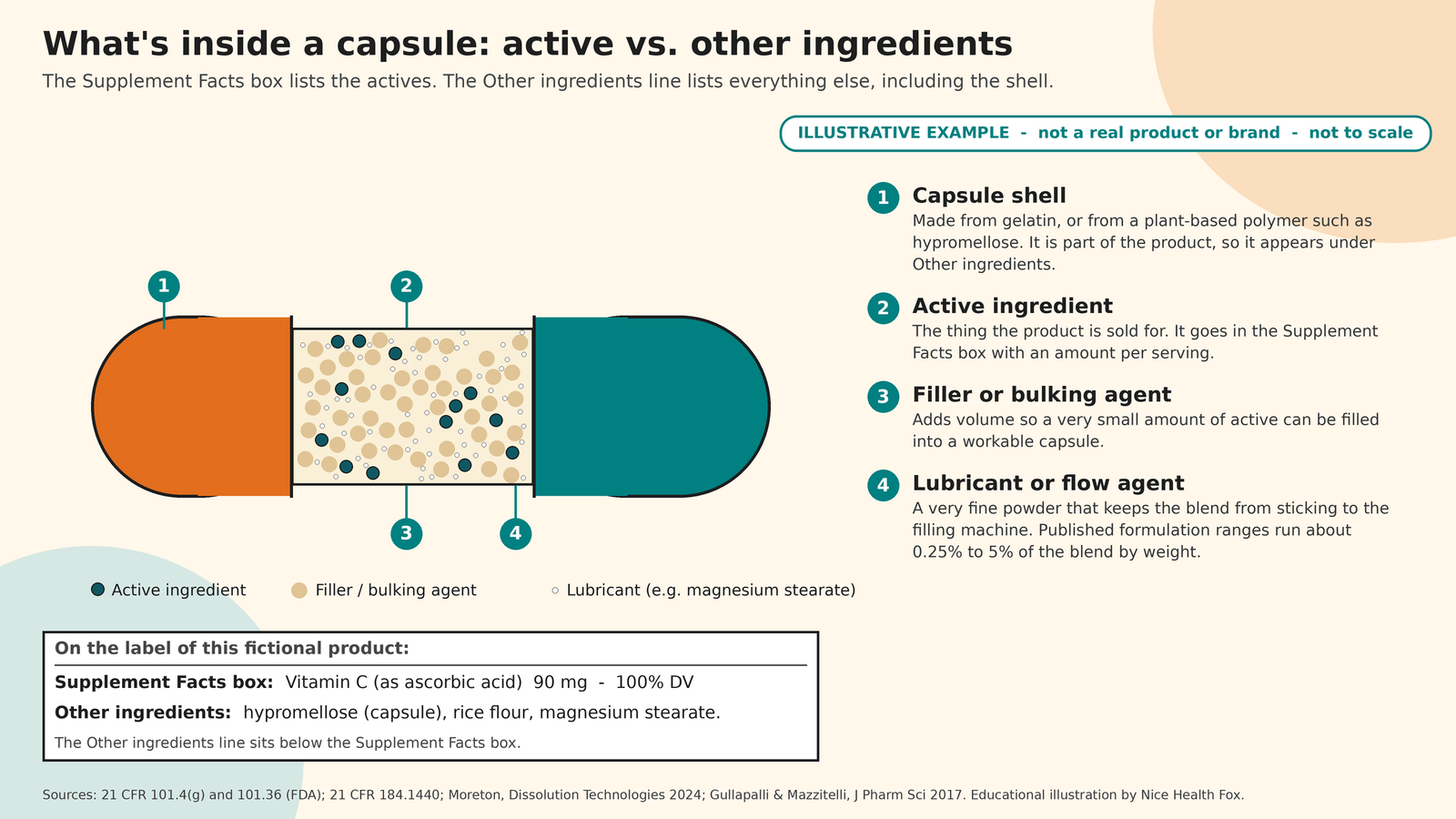
An unfamiliar name on this line isn’t automatically a red flag. It’s a prompt to look it up. Our guide to reading a supplement label shows how the rest of the panel fits together.
What magnesium stearate is, and why it’s in your capsule
Chemically, it’s a mix of magnesium salts of stearic acid and palmitic acid. The international food additive committee (JECFA) describes it as made from edible fats and oils and containing roughly 4 to 5 percent magnesium. If you’ve compared forms of the mineral in our magnesium glycinate vs citrate guide, don’t confuse the two: magnesium stearate isn’t sold as a way to get magnesium. It’s a processing ingredient.
The job is lubrication. When powder is pressed into a tablet or filled into a capsule at speed, it wants to cling to punches, dies and filling pins. A thin coating of magnesium stearate particles acts as a boundary layer between the powder and the metal. Published pharmaceutical references put typical use somewhere between 0.25% and 5% of the blend by weight, and most often around 0.5% to 1%.
To make that concrete, here’s simple arithmetic, not a statement about any particular product. If a capsule holds 500 mg of powder and 1% of it is magnesium stearate, that’s 5 mg. At the very top of the published range, 5%, it’s 25 mg. With 4 to 5 percent magnesium by weight, 5 mg of magnesium stearate contains roughly a quarter of a milligram of magnesium. That’s a rounding error next to the amount of magnesium you eat in a day.
The stearic acid half is no stranger to your body either. It’s one of the most common saturated fats in food, and it’s found in cocoa butter, shea butter and animal fats. A USDA technical report on the additive notes cocoa butter and shea butter are around 28 to 45 percent stearic acid, and it behaves differently from other saturated fats: an analysis pooling data from many controlled feeding studies found stearic acid had a neutral effect on blood cholesterol, unlike palmitic acid (Yu et al., 1995).
The safety record: what regulators and toxicologists found
United States. FDA’s regulation at 21 CFR 184.1440 affirms magnesium stearate as GRAS for food use. It lists the purposes as lubricant and release agent, nutrient supplement and processing aid, with no limit other than current good manufacturing practice. Supplements are regulated as a category of food, which is why the rule matters here.
Europe. In 2018, EFSA re-evaluated the magnesium salts of fatty acids (E 470b). It concluded they raise no safety concern at the reported uses and use levels, and that no numerical acceptable daily intake was needed. Its reasoning: in the gut they separate into the fatty acids and the magnesium, both of which were already assessed. JECFA reached a similar “not specified” ADI in 2015.
Lab toxicity work. A 2017 study tested magnesium stearate in both test-tube and animal genotoxicity assays and found no sign of DNA-damaging potential (Hobbs et al., Toxicology Reports).
We’d be overselling if we left out the limits. EFSA itself pointed out that there are no subchronic, chronic or reproductive toxicity studies on the salts, and relied on the breakdown products instead. JECFA flagged that magnesium salts used as additives, taken together across many foods, could have a laxative effect at high intakes. That concern is about total additive exposure in the diet, not the milligrams in a capsule. We found no study linking supplement-level magnesium stearate to stomach upset.
One more honest footnote: we found a single short published report of an allergic reaction (hives) linked to magnesium stearate (Tammaro et al., 2012, titled “Magnesium stearate: an underestimated allergen”). One report isn’t a pattern. But it’s a reminder that any ingredient can trigger a reaction in someone, which is why our side-effects checklist tells you to note what’s in the product when something doesn’t agree with you.
Myth vs evidence: the viral claims
Each of these claims has a grain of something real in it, which is why they stick. Here’s what’s actually behind each one.
“It suppresses your immune system” (the T-cell study)
The claim usually points to a 1990 paper (Tebbey and Buttke, Immunology). It’s a real paper. What it did: researchers grew mouse immune cells in a dish and exposed them to stearic acid. T cells that had been activated in the dish were harmed. B cells weren’t.
What it didn’t do: use magnesium stearate, use human cells, or look at anything swallowed in a capsule. It doesn’t tell you what happens when you take a supplement. And since stearic acid is already part of normal diets, a dish result with a concentrated dose of the fatty acid isn’t a finding about food or capsules. We found no human study showing that supplement magnesium stearate affects immune function.
“It forms a biofilm in your gut”
We looked for the source of this one and came up empty. We found no study showing magnesium stearate forming a biofilm in the human gut. Some websites cite a 2008 paper on stearic acid as proof, but that paper is about bacterial chemical signalling, not biofilms, so we haven’t repeated that claim.
What exists is test-tube work on fatty acids and bacterial biofilms, and it points in different directions depending on the bacterium and the fatty acid. One Listeria study, for example, found stearic acid increased biofilm formation in a lab model. That’s exactly why dish results shouldn’t be turned into gut claims in either direction. “Biofilm” is a vivid word, and it has been attached to this ingredient without the research to support it.
“It blocks absorption”
This one has the most truth in it, so it deserves the most careful answer.
In the lab, magnesium stearate is water-repellent. If a manufacturer uses too much, or blends it too long, the particles can coat the powder and slow the speed at which a tablet or capsule dissolves. Pharmaceutical scientists know this and manage it, since it’s why the amount is kept small and the mixing time controlled (Moreton, Dissolution Technologies, 2024).
Slower dissolving in a test isn’t the same as less absorbed by a person. A mechanistic review of excipients and drug absorption found no evidence in people of an effect for many excipients, and judged an effect on the absorption of highly soluble, well-absorbed drugs very unlikely (Flanagan, European Journal of Pharmaceutics and Biopharmaceutics, 2019). That review is about medicines, and we found no human study showing that supplement-level magnesium stearate reduces the absorption of vitamins or minerals.
So the fair reading is: it’s a real formulation variable, handled through design and testing, and not a demonstrated problem for people taking ordinary supplements.
“It’s a toxic, unnatural filler”
It’s made of magnesium and two fatty acids found in everyday food. “Unnatural” doesn’t describe it, and “toxic” doesn’t match the regulatory reviews above. It is also a processing aid with no benefit for you, which is a different thing from being harmful.
Who might still want to avoid it
Nothing here means you must keep it. There are reasonable personal reasons to skip it:
- Vegetarian or vegan diets. The fats used to make it can be plant or animal. A label rarely says which. If it matters to you, look for a statement on the label or ask the maker. A vegetable-derived version is common and is often preferred by manufacturers, but we can’t tell you that any given bottle uses one.
- You’ve reacted to a product that contained it. Given the case report above, tell your pharmacist and bring the label.
- You prefer shorter ingredient lists. That’s a fair preference.
A “no magnesium stearate” claim on the front of a bottle isn’t evidence that the product is safer or better. Makers who leave it out use a different lubricant, or make the capsule a different way, and each option has its own trade-offs. Judge the product by the full label and any independent testing, not by one missing ingredient.
If you take prescription medicine, treat your pharmacist as the person to ask about any supplement. That’s true whether or not magnesium stearate is on the label.
Notes for the UK, Australia and Canada
United Kingdom. Magnesium salts of fatty acids are listed as E 470b on the Food Standards Agency’s register of authorised food additives for Great Britain, and are covered by the assimilated version of Regulation (EC) No 1333/2008. The identity specification sits in Regulation (EU) No 231/2012 as retained in GB law.
Australia. The TGA’s Permissible Ingredients Determination (No. 2) 2026 lists magnesium stearate (item 3172) as an excipient, with no extra restriction attached. Animal-derived ingredients used in these medicines have to meet the TGA’s requirements for managing the risk of transmissible spongiform encephalopathies, which follow the European Pharmacopoeia. In plain terms: it’s an allowed ingredient, and the animal-source question is something the sponsor has to handle.
Canada. Health Canada’s Natural Health Products Ingredients Database lists magnesium stearate as a non-medicinal ingredient with listed purposes, and Canadian natural health product labels include a list of non-medicinal ingredients.
Rules change and details vary by product type, so check the current rules for your country if it matters to you.
Frequently asked questions
Is magnesium stearate bad for you?
Not at the amounts used in supplements, based on what we found. FDA lists it as GRAS for food use, and EFSA found no safety concern at reported uses. The honest caveats are small: no long-term toxicity studies on the salts themselves, one case report of an allergic reaction, and a personal-preference issue for vegetarians.
Why do supplement makers use magnesium stearate?
It’s a lubricant. Without something like it, powder sticks to the filling machinery and doesn’t flow evenly, so capsules end up inconsistent. It’s used in small amounts, usually well under a few percent of the blend.
Does magnesium stearate stop my supplements from being absorbed?
In lab dissolution tests, too much of it can slow how fast a tablet or capsule breaks down. In people, reviews say a meaningful effect is unlikely for many drugs, and we found no human study showing it blocks vitamin or mineral absorption at supplement-level amounts. If you take a time-sensitive prescription, ask your pharmacist about any supplement.
Does magnesium stearate weaken the immune system?
No human evidence says so. The study behind the claim used stearic acid, not magnesium stearate, on mouse cells in a dish, and it doesn’t describe what happens when someone takes a capsule.
Is magnesium stearate vegan?
It depends on where the fat came from. It can be made from plant oils or animal fats, and labels usually don’t say. If this matters to you, look for a vegetable-source statement or ask the manufacturer.
Should I avoid supplements that contain magnesium stearate?
You don’t need to on safety grounds, based on current evidence. Avoiding it is reasonable if you’re vegetarian or vegan and can’t confirm the source, or if you’ve reacted to it before. Don’t treat its absence as proof that a product is better. Read the whole label.
What does “other ingredients” mean on a supplement label?
It’s the line listing everything in the product that isn’t an active ingredient in the Supplement Facts box: the capsule shell, fillers, flow agents, lubricants, coatings and flavours. In Canada it’s called “Non-medicinal ingredients.” See our label-reading guide for the rest of the panel.
The takeaway
Magnesium stearate is one of the most common ingredients you’ll meet on the Other ingredients line, and one of the most over-hyped. The research doesn’t support the immune, biofilm or absorption claims for supplement-level use, and regulators haven’t found a safety concern. It also isn’t doing anything for you, so choose it or skip it based on your own preferences, not fear.
Want more like this? Browse Supplement Safety, and use the side-effects checklist before you add anything new.
Sources
- U.S. Government Publishing Office / eCFR. 21 CFR 184.1440 – Magnesium stearate.
- FDA. Food Labeling Guide, ingredient labeling and 21 CFR 101.4(g), 101.36.
- EFSA Panel on Food Additives and Nutrient Sources. Re-evaluation of sodium, potassium and calcium salts of fatty acids (E 470a) and magnesium salts of fatty acids (E 470b) as food additives. EFSA Journal 2018;16(3):5180. doi:10.2903/j.efsa.2018.5180.
- JECFA. Magnesium salts of fatty acids: specifications and ADI “not specified” (2015). Cited second-hand via item 5.
- USDA Agricultural Marketing Service. Technical evaluation report on magnesium stearate (processed products).
- Moreton RC. Magnesium stearate: its importance and potential impact on dissolution of oral solid dosage forms. Dissolution Technologies 2024;31(3). doi:10.14227/dt310324p122.
- Flanagan T. Potential for pharmaceutical excipients to impact absorption: a mechanistic review for BCS Class 1 and 3 drugs. Eur J Pharm Biopharm 2019;141:130-138. doi:10.1016/j.ejpb.2019.05.020.
- Tebbey PW, Buttke TM. Molecular basis for the immunosuppressive action of stearic acid on T cells. Immunology 1990;70(3):379-384.
- Hobbs CA, Saigo K, Koyanagi M, Hayashi SM. Magnesium stearate, a widely-used food additive, exhibits a lack of in vitro and in vivo genotoxic potential. Toxicol Rep 2017;4:554-559. doi:10.1016/j.toxrep.2017.10.003.
- Yu S, et al. Plasma cholesterol-predictive equations demonstrate that stearic acid is neutral and monounsaturated fatty acids are hypocholesterolemic. Am J Clin Nutr 1995;61:1129-1139.
- Tammaro A, Abruzzese C, Narcisi A, et al. Magnesium stearate: an underestimated allergen. J Biol Regul Homeost Agents 2012;26:783-784.
- Gullapalli RP, Mazzitelli CL. Gelatin and non-gelatin capsule dosage forms. J Pharm Sci 2017;106:1453-1465. doi:10.1016/j.xphs.2017.02.006.
- UK Food Standards Agency. Register of authorised food additives (GB), E 470b.
- Therapeutic Goods Administration. Therapeutic Goods (Permissible Ingredients) Determination (No. 2) 2026, item 3172.
- Health Canada. Natural Health Products Ingredients Database (NHPID), magnesium stearate.