
Disclosure: This article may contain affiliate links. If you buy through these links, we may earn a commission at no extra cost to you. Our recommendations are based on editorial criteria, not commission rates.
By the Nice Health Fox Editorial Team · Updated November 12, 2026 · About 9 minutes to read
The same capsule can read 50% on a US label and 200% on a UK one. Nothing about the capsule changed. US labels show %DV (percent of the Daily Value, set by the FDA) and UK labels show %NRV (percent of the Nutrient Reference Value, set in retained UK law), and the two tables use different reference amounts for most vitamins and minerals. A 10-microgram vitamin D capsule is 10 ÷ 20 = 50% DV in the US and 10 ÷ 5 = 200% NRV in the UK.
Neither percentage is a limit, a target or a recommendation. They’re yardsticks, and each country uses its own. Below: how each label works, a side-by-side table of eight common nutrients with every value checked against the official source, how to convert between them, and short notes for Australia and Canada.
Quick answer
- US: the percentage is %DV. The FDA sets the Daily Value for each nutrient, and the label shows the percentage per serving.
- UK: the percentage is %NRV. The reference values are in Annex XIII of the retained food information regulation, and the label shows the percentage per recommended daily dose.
- Why they differ: different reference tables. Vitamin D is 20 mcg in the US and 5 µg in the UK, so the UK percentage is four times higher for the same amount. Calcium is 1,300 mg vs 800 mg, iron 18 mg vs 14 mg.
- Formula (both countries): amount ÷ reference value × 100.
- The catch: forms and units can differ too. US folate is in mcg DFE, UK folic acid is in µg, and US vitamin D may add IU in brackets.
- Best habit: compare the amounts (mg or µg), not the percentages, whenever you’re looking at a label from another country.
General education only, not medical advice. A percentage on a label isn’t personal advice. If you take prescription medicine or are pregnant, show the label to your pharmacist first. Our supplement side-effects checklist covers what to do before you start something new, and Supplement Safety collects our other label guides.
The same capsule, two labels
Here’s one made-up capsule, with identical amounts, on a US-style panel and a UK-style panel. Only the reference value changes, so only the percentages change.
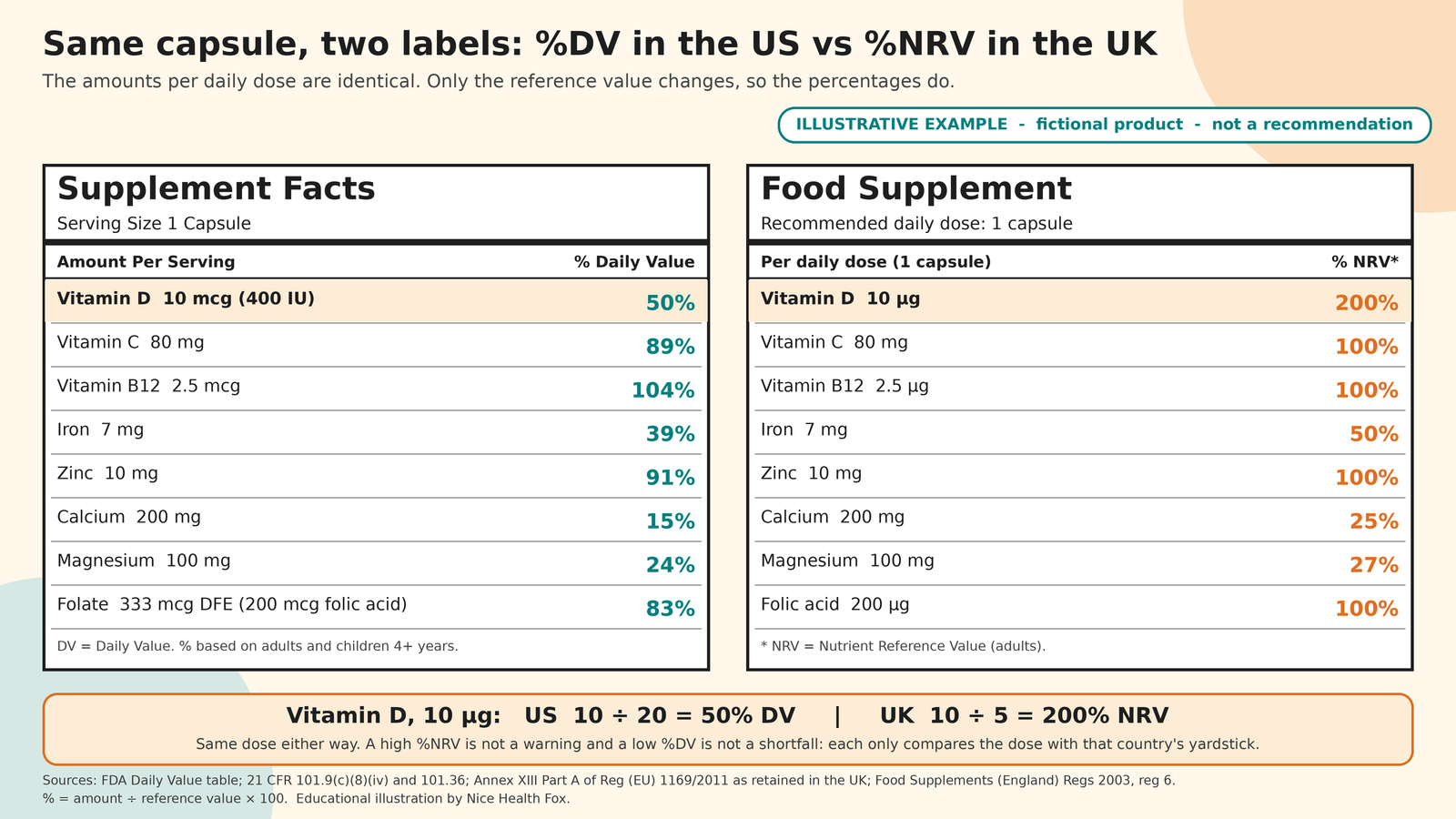
Two things jump out. Vitamin D is the big swing: 50% on one side, 200% on the other. And B12 goes the other way: 2.5 µg is 104% of the US value but exactly 100% of the UK one, because the US value is slightly lower (2.4 vs 2.5).
How each label is built
The percentages differ because the rules differ. Here’s what each system actually requires.
United States: Supplement Facts and %DV
Under 21 CFR 101.36, a US supplement carries a Supplement Facts panel. It starts with a serving size, and each vitamin or mineral that has a Daily Value gets an amount and a % Daily Value. A few details that matter when you compare:
- The percentage is per serving. If the serving is two capsules, every number on the panel is for two capsules. The rule lets a maker add per-unit or per-day columns, but the serving column is the one that’s required.
- The math is simple. The percentage is the amount divided by the Daily Value, times 100, rounded to the nearest whole percent. (The regulation says the calculation uses the unrounded amount.)
- The amount is the nutrient, not its source. Calcium is declared as the weight of calcium, not of the calcium carbonate it comes in.
- Vitamin D is in mcg. Micrograms are required. International units (IU) may be added in brackets after.
- The default group is adults and children aged 4 and over. If a product is made for infants, toddlers aged 1 to 3, pregnant women or lactating women, the panel has to show the percentage for that group, with its own column, and the reference values for those groups are different. The FDA’s table (21 CFR 101.9(c)(8)(iv)) carries a separate column for each.
The FDA’s own consumer page gives a general rule of thumb: 5% DV or less of a nutrient per serving is low, and 20% DV or more is high. That’s a way to compare foods, not a verdict on a supplement.
United Kingdom: food supplements and %NRV
In Great Britain a supplement is legally a food supplement, and the words “food supplement” must be the sales name. The rules sit in the Food Supplements (England) Regulations 2003 (Scotland has a matching set, and its regulation 6 reads essentially the same). GOV.UK describes these as the rules implementing Directive 2002/46/EC. Regulation 6 says the label must give:
- the amount of each vitamin, mineral or other substance with a nutritional or physiological effect, in numbers, using the unit set for that nutrient;
- that amount per portion recommended for daily consumption, as an average from the manufacturer’s analysis; and
- for a vitamin or mineral on the Annex XIII list, also a percentage of the reference value (a graphic version is allowed).
The same regulation requires a warning not to exceed the stated recommended daily dose, a statement that food supplements shouldn’t replace a varied diet, and a statement to keep the product out of the reach of young children.
The reference values themselves are in Annex XIII, Part A of Regulation (EU) No 1169/2011 as it stands in UK law. The Annex is headed “U.K. daily reference intakes for vitamins and minerals (adults)”. It gives one value per nutrient, for adults.
That’s the key structural difference. A UK percentage is always against the adult value and the daily dose. A US percentage is against the value for whichever group the product is made for, and the serving.
Side-by-side: the eight most-asked nutrients
Every value below was checked against the official source: the FDA’s Daily Value reference table (cross-checked with the table in 21 CFR 101.9(c)(8)(iv)) and Annex XIII, Part A on legislation.gov.uk.
| Nutrient | US Daily Value (adults and children 4+) | UK NRV (adults) | UK % ÷ US % for the same amount |
|---|---|---|---|
| Vitamin D | 20 mcg (800 IU) | 5 µg | ×4.00 |
| Vitamin C | 90 mg | 80 mg | ×1.13 |
| Vitamin B12 | 2.4 mcg | 2.5 µg | ×0.96 |
| Iron | 18 mg | 14 mg | ×1.29 |
| Zinc | 11 mg | 10 mg | ×1.10 |
| Calcium | 1,300 mg | 800 mg | ×1.63 |
| Magnesium | 420 mg | 375 mg | ×1.12 |
| Folate | 400 mcg DFE | 200 µg (listed as folic acid) | depends on the form, see below |
The last column is our arithmetic: US value ÷ UK value. A multiplier above 1 means the UK label shows a higher percentage for the same amount. mcg and µg are the same unit (micrograms). The IU figure for vitamin D comes from the FDA/NIH conversion of 1 mcg = 40 IU.
Both lists run well beyond these eight. Each has 27 vitamins and minerals, but not the same 27: choline has a US Daily Value and isn’t in the UK list, while fluoride is in the UK list and has no US Daily Value.
Some of these gaps are small and some aren’t. The pattern: for six of the seven directly comparable nutrients, the UK reference is the lower one, so the same amount makes a bigger percentage on a UK label. B12 is the exception.
Converting between the two
You only need one formula, and it works in both directions:
% = amount ÷ reference value × 100
To translate a label from the other country, ignore its percentage. Take the amount and divide by your own country’s reference value.
Vitamin D. A US panel reads “Vitamin D 10 mcg (400 IU), 50%”. In UK terms that’s 10 ÷ 5 = 200% NRV. If a UK label says “Vitamin D 10 µg, 200% NRV”, it would be 10 ÷ 20 = 50% DV in the US. (The IU figure is just the same amount in older units: 1 mcg = 40 IU.)
Calcium. 200 mg is 200 ÷ 1,300 = 15% DV in the US and 200 ÷ 800 = 25% NRV in the UK.
Folate: the tricky one. The US doesn’t count folic acid and food folate as equal. Its unit is the DFE, the dietary folate equivalent, where the regulation says 1 DFE equals 1 mcg of naturally occurring folate or 0.6 mcg of folic acid. A UK label lists folic acid in plain micrograms. So 200 µg of folic acid, which is 100% NRV in the UK, works out to 200 ÷ 0.6 = about 333 mcg DFE, or 83% DV in the US. And a US label that reads “Folate 400 mcg DFE (240 mcg folic acid)” is 240 ÷ 200 = 120% NRV in UK terms. The US rule is that when folic acid is added, its amount in mcg is declared in brackets as well, which is why you’ll see two numbers.
Vitamins A and E. The units differ in name as well. The UK list uses µg RE for vitamin A and mg α-TE for vitamin E. The US list uses mcg RAE for vitamin A and mg of alpha-tocopherol for vitamin E. We haven’t built a conversion for these here. If you’re comparing them, check which unit each label uses before you divide.
What the percentage does and doesn’t tell you
It isn’t a limit. The FDA describes Daily Values as the recommended amounts of nutrients to consume or not to exceed each day, and the label percentage as how much of that a serving contributes. But they’re labelling references. Upper limits are separate numbers, and they are set separately. The NIH Office of Dietary Supplements publishes upper limits for many nutrients in its fact sheets, and your pharmacist can help you read a total across products. A label showing more than 100% isn’t automatically a problem, and one showing less isn’t a shortfall. UK law separately requires a warning not to exceed the stated recommended daily dose.
It isn’t the same thing as an RDA. Recommended Dietary Allowances are age- and sex-specific. The Daily Value is one number on a label. For vitamin D, for instance, NIH lists RDAs of 15 to 20 mcg depending on age, while the Daily Value is 20 mcg for everyone four and over.
It tells you nothing about the form or quality. Two products with the same %NRV can differ in the form of the nutrient, the other ingredients, and the testing behind them. Our label guide covers serving size, blends and seals, and our post on magnesium stearate explains what’s typically in the “other ingredients” line.
Check what the percentage is “per”. In the UK it’s per recommended daily dose. In the US it’s per serving, and the serving might not be the daily dose. If the label suggests two servings a day, double the panel.
Buying across the border
A few practical habits help when a product from one country ends up in the other.
- Read the amounts first. A figure in mg or µg means the same thing everywhere. A percentage doesn’t.
- Look for the right name. UK law requires the words “food supplement”. A product sold in the UK that says only “dietary supplement” and shows only %DV was probably designed for the US market.
- Check the units and forms. Folate as DFE or folic acid, vitamin D with or without IU, and vitamin A as RAE or RE.
- Check who the numbers are for. US panels can show percentages for infants, toddlers, or pregnant or lactating women. The UK Annex XIII values are adult values.
- If it matters medically, ask. Pregnancy, children, long-term conditions and prescription medicines are all reasons to have a pharmacist read the label with you. Our post on whether supplements can replace prescription medication covers the limits.
This article covers Great Britain. Wales has its own matching regulations, and Northern Ireland has separate equivalent rules. We haven’t checked those.
Notes for Australia and Canada
Australia. Australia works differently. The TGA lists as a prohibited representation in advertising any statement of the amount of a vitamin or mineral in a product “as a percentage or proportion of the recommended daily or dietary intake or allowance.” Such representations are allowed only in limited circumstances with TGA permission. The rule is in Schedule 2 of the Therapeutic Goods Regulations 1990, and the TGA’s page was last updated in March 2025. We haven’t verified how it applies to the printed panel on a pack, so the practical advice is: read the stated amount of each ingredient and look for the AUST number.
Canada. Natural health products use a Product Facts table. Health Canada’s labelling guidance says the table lists each medicinal ingredient with its quantity per dosage unit, from highest to lowest quantity, with the source material in brackets. The required content doesn’t include a percentage column. Health Canada also accepts “mcg” and “mg” as the bilingual abbreviations. The new table format came into force on 21 June 2025, and Health Canada gives all natural health products until 22 June 2028 to comply, so you may see both layouts on shelves.
Frequently asked questions
What does %NRV mean on a supplement label?
It’s the percentage of the Nutrient Reference Value that one recommended daily dose supplies. NRVs for vitamins and minerals are set in Annex XIII of the retained food information regulation, and UK food supplement rules require the percentage next to the amount for listed vitamins and minerals. Divide the amount by the NRV and multiply by 100 to check it.
What’s the difference between NRV and DV?
They do the same job with different numbers. The Daily Value is the FDA’s reference for US labels and the NRV is the UK’s reference in law. For example, vitamin D is 20 mcg in the US and 5 µg in the UK, and calcium is 1,300 mg versus 800 mg. They also apply differently: the US percentage is per serving, and the UK one is per recommended daily dose.
Why does the same vitamin D capsule show 50% in the US and 200% in the UK?
Because the reference values differ by a factor of four. A 10 µg capsule is 10 ÷ 20 = 50% of the US Daily Value and 10 ÷ 5 = 200% of the UK NRV. The capsule is identical. A percentage over 100 isn’t a warning, and under 100 isn’t a shortfall.
Is over 100% of the NRV or DV dangerous?
Not automatically. These percentages compare the amount with a labelling reference, not with a safe upper limit. Upper limits are separate numbers, which NIH lists in its fact sheets. If a label shows a very high percentage, or you take several products with the same nutrient, ask a pharmacist to look at the total. The UK also requires a warning not to exceed the stated daily dose.
Can I compare a UK label with a US label directly?
Compare the amounts, not the percentages. The units (mcg and µg) are the same, but the percentages use different yardsticks. Check the forms too, especially folate (DFE vs folic acid) and vitamin D (IU in brackets), and check whether the numbers are per serving or per daily dose.
Is %NRV the same as %RDA or %RI?
The terms get used loosely. GOV.UK’s older 2011 summary on supplement labelling talks about a “recommended daily allowance”, the current regulation says “reference value”, and the FSA’s guidance for ordinary foods says to use the generic term “reference intakes”. On a UK supplement you’ll normally see %NRV. RDA in the US is a different thing: age- and sex-specific allowances published by the National Academies, not the single Daily Value printed on a label.
Do Australia and Canada use %DV on supplements?
Not in the way the US and UK do, based on what we checked. In Australia, the TGA treats expressing a vitamin or mineral amount as a percentage of recommended intake as a prohibited representation in advertising. In Canada, natural health product labels use the Product Facts table, which lists quantity per dosage unit and has no percentage column in its required content.
The takeaway
The %NRV and %DV aren’t mistakes or marketing tricks. They’re two regulators’ yardsticks, and they disagree because the tables behind them are different. When you pick up a label from another country, ignore the percentage and read the amount, the unit and the serving or daily dose. Then do one division. That’s all it takes.
For the rest of the panel, from serving size to blends to seals, see our guide to reading a supplement label, and browse Supplement Safety for more.
Sources
- U.S. Food and Drug Administration. Daily Value on the Nutrition and Supplement Facts Labels (reference guide: Daily Values for nutrients).
- eCFR. 21 CFR 101.36 – Nutrition labeling of dietary supplements.
- eCFR. 21 CFR 101.9(c)(8)(iv) – Reference Daily Intakes (RDI table and footnotes, including DFE and folic acid).
- legislation.gov.uk. Regulation (EU) No 1169/2011, Annex XIII – U.K. reference intakes (Part A, point 1).
- legislation.gov.uk. The Food Supplements (England) Regulations 2003, regulation 6.
- legislation.gov.uk. The Food Supplements (Scotland) Regulations 2003, regulation 6.
- legislation.gov.uk. The Nutrition (Amendment etc.) (EU Exit) Regulations 2019, Schedule 1 (units for vitamins and minerals in food supplements).
- GOV.UK. Food supplement use and labels (Department of Health and Social Care; includes the 2011 “Summary information on the labelling of food supplements”).
- Food Standards Agency / GOV.UK. Technical guidance on nutrition labelling (definition of nutrient reference values; “reference intakes” wording for ordinary foods).
- NIH Office of Dietary Supplements. Vitamin D: Fact Sheet for Health Professionals (1 mcg = 40 IU; RDAs; Daily Value).
- Therapeutic Goods Administration (Australia). Restricted and prohibited representations in advertising.
- Therapeutic Goods Regulations 1990, Schedule 2 (prohibited representations), item 9; text as shown on AustLII.
- Health Canada. Guidance document: Labelling of natural health products.